MERCURY or Hermes? FLORA 
unfortunately for Mercury, a god very dear to me, is primarily the story of his Greek counterpart, Hermes, or Hermes, as it means, but it is not Romanized, and then turned this personification of the deity. you know what this is about:
Mercury is considered the messenger of the gods, son of the god Jupiter and Maia, daughter of the titan Atlas.
For Mercury was the Roman god of commerce, and especially its name was derived from Merx (goods) and mercari (trade). To honor this god in Rome was founded the college of merchants, whose members were called Mercuriales.
In Rome, a temple dedicated to him was erected in the Circus Maximus, the Aventine Hill in 495 BC
The fact that the same God protect thieves, doctors and merchants ironically indicates their consideration at the world classico.Solo imperial era, as evidenced by the work of Virgil, borrowed from his correspondent the greek functions as a messenger of the gods and guide of dead souls.
on him we hear these words from an unknown author:
" God with other gods and goddesses lived on Mount Olympus and the sound of the lira enjoyed their feasts, but every once held a commission as a messenger . It gave the order of the men and women, applied to its shoes and boots and wings appeared to men. Once the god Mercury appeared to Aeneas and warned Aeneas, as the poet Virgil tells us in his famous work: one based New Troy on the shores of Italy! Let the queen and her kingdom, and obey your fate!
So Mercury gets obedience: the pious Aeneas it leaves the coast of Africa, with his companions and his son Ascanio touches the coast of Italy and founded a new city. However, Mercury is not only the messenger of the gods. The inhabitants of all arcadia dedicated to Mercury, the god of commerce, dreams, (doli) and temples of the pastures. The inhabitants of the whole of Greece also built the statues of Hermes and Mercury, especially in Athens. But also the roosters, says Caesar, honoring the god Mercury with other gods and goddesses. The Gauls are engaged in commerce and ask for his help. No god prepares a (dolum) needed the money and walk ways, without any danger. In fact, Mercury is the patron saint of the streets. "
one of the legends associated with this wily God is the one that sees him act against Argo: To hide the true identity of Io Juno, Jupiter turned the girl in the heifer, but the goddess, the jealous rival, would still get the animal as a gift. Jupiter, in order to dispel any suspicion of treason, he agreed to the request, and Juno put the girl under the supervision of Argos. The shepherd had a hundred eyes scattered all over the head, and because these could not ever sleep, to rest as it closed only two at a time, while the other remained open. Sorry for the sad fate that had caused the girl, Jupiter, Mercury instructed his son to free her. To get close to Argos, the god disguised himself as shepherd, after taking off the helmet and the wings, and they have taken with him only the rod and the syringe, the guard walked up to playing a tune. Argo, fascinated by the sound, he invited the god to sit with him and Mercurio began to play a long time, the pastor telling the story of Pan and Syrinx, until he could not sleep for close to all the hundred eyes. Then God took his sword and cut off his head, allowing them to free Io. Juno, sorry for the sad fate happened to the pastor, he took his eyes from his head and placed them on the feathers of the peacock, her sacred animal.
Mercury never became an important god to the Roman state, so they do not have a Flamen but its popularity was significant and continued to grow with the growth of trade and power of Rome.
His feast was celebrated on May 15 he was offered incense, and sprinkling it was the custom of the merchants themselves and their goods with the water that flowed from a source outside the city Capena (aqua Mercury).
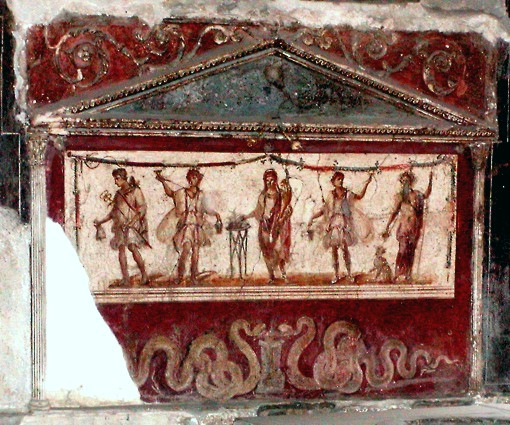
was represented almost naked, or covered by the cloak, bearing in his right hand a bag of money (crumena) and in his left the caduceus and the wings on his feet.
for completeness we also examine the story to his Greek counterpart.
Hermes (Latin Mercurius, Mercury), or Hermes, is the son of Zeus and Maia, one of the many representations of the Mother Earth, and appears to have been born on Chilean mountain in Arcadia. Her legend is reported by Apollodorus and Aristophanes. He was described as a young man with a helmet and winged sandals wielding a caduceus with two serpents, in memory of those who one day had stuck to his stick as he tried to divide them.
Hermes can be found in the metaphor of the action, the practice of concentration and activity. It is likely that originally it was a kind of phallic deity, a "rogue divine" that is to symbolize the coupling and the mechanism of generation. The story ultimately
is always the same, with the father of the gods: Zeus fell in love with Maia and her mother made. Maia was the daughter of Atlas and his son took it when he was born on Mount Chilean and covered it with sides and laid him in a basket story. The Goddess was hoping to enjoy their childhood of his son, but he soon became different from all other infants, not just placed in the basket quickly became a teenager. His mother had just turned his back and had fallen asleep, that Hermes, already robust and vital, took to flight, away from the mother and nymphs who guarded him. Fleeing
arrived in Pieria. There were kept cows owned by Apollo, the god and the scoundrel stole and covered with a trick his escape. When Apollo purpose theft promised a reward to anyone who would provide information on the theft. Meanwhile, Hermes had hidden the cows in a cave on the banks of the river Alpheus, and was returned by his mother, who still slept. was discovered as a thief in the herd of Apollo because of his love for music: He saw a turtle upside down and took it. Then killed a few cows in the herd and put the insides to dry. Applied to the shell of the turtle innards of some strings obtained thus inventing the lyre. He touched the strings with a chip and the tool gave sounds extraordinary. Hermes began to play softly enchanting mother and satyrs who lived in the area. As soon as they saw the harp knew it was made with the entrails of cows stolen, because there were no cattle in that area. They decided to accuse the god of theft, but the nymph who acted as his nurse, Hermes asked how it was possible that a child so small and so naive could commit a serious theft. The Satyrs were convinced and they went away. But Apollo was not to be charmed, took the child and took him to Zeus. The latter, who loved Hermes for his cunning and tenacity, Apollo away with an excuse, he invited the child to plead not guilty even in the face of evidence that the accusation. But Apollo was inflexible and eventually Herman was forced to confess, to apologize and return the herd. To appease the anger of the god Hermes admitted that he killed a few cows, but to have the meat sacrificed in her honor, Apollo's wrath subsided, proud for that sacrifice.
Hermes took him to the secret hideout and Apollo amazed by his ability, he asked to swap the harp with the entire herd. Hermes agreed. Apollo amazed and amused the skill of the young god made him the protector of herdsmen, granting him the authority on divination with stones and giving him the stick (in greek kerykeion, caduceus in Latin) as a symbol of his power. Hermes was the same picture, with a ram on his shoulders and he was also known by the title of Nomios (pasture).
Hermes, deprived of his instrument, he endeavored to invent another; invented a reed flute, which turned out to have a more melodious sound of that harp. Apollo immediately wanted to have this new tool, and proposed an exchange to Hermes, who accepted the exchange with a staff of gold which was used to drive cattle and also asked the secret of divination. Apollo sent him from Trie, who were her attendants, to teach him to recognize future events from the analysis of the stones thrown to the ground repeatedly.
Hermes asked Zeus to become the messenger of the gods, and they made him the protector of merchants and travelers, thieves and inventors. Zeus gave him gifts in gold sandals that allowed him to fly at any speed.
At this point, Hermes was because he knew he wanted to reconcile with his cruelty towards the children of Zeus. Disguised as a child, he sat on his lap to be fed, in this way was, consciously or unconsciously, became his foster mother and was forced to treat him with the respect due to a child. Hermes
firms all have a vitalistic character. His behavior is highly immoral, uninterested in the ethical problem, and leads, from birth, through the theft and the confusion lies. The ability to redeem his great great. The artistic invention lighted in the figure of Hermes has its dark counterpart. The artist seems to mix the sinner or otherwise immorality with the spirit of world knowledge that is peculiar to the child.
The gold bullion which the myth is mentioned, will become the symbol of Hermes and often interpreted as a symbol of sexual power. The gold bullion is considered a symbol of the spine along which meander as intertwined, the two fundamental polarities sexual expression. It is perhaps in the light of this interpretation, which also became the patron of prostitutes, representatives of the absolute freedom and sexual immorality.
For its excellent relations with Hades, Hermes is considered the protector of the death in his leadership of the shadows to the abode of Hades, and this symbolism can be compared with the Egyptian god Anubis.
Hermes had many loves, especially loved among the goddesses Aphrodite and Priapus who begat Hermaphrodite. First, the goddess refused his short but Zeus took pity on him and sent his eagle, because he stole a gold goddess sandals as she was bathing in the river Achelous. Hermes offered to return the favors in exchange for his sandal, and the goddess accepted.
With a nymph or daughter Driope, called Penelope, father of Pan.
The figure of Hermes is the most esoteric in the panorama of Greek gods because of his relationship with music. Music has always been considered of high therapeutic value in all the so-called primitive cultures. Hermes invented the music and being the owner of the caduceus, we show how the divinity of the fundamental biological rhythm and sex. The interest shown by the divination Hermes is one of the reasons for his esoteric cult.